I am a wreck.
I am so on top of things for my leaving-the-country move that it is driving me insane. I tried to pay a parking ticket too early, before the city of Denver even put the citation number into their database. Then I tried to pay it again, and again, for a total of three times, and it is still not there.
The problem with this is that there is no middle ground for me. I am either on top of things, or I am not. I can either pay this ticket now, or when I come back from Spain I will owe the city of Denver enough money to build some new high-tech infrastructure.
I was talking to my sister Kristi about this when I went to Hawaii for her wedding a few weeks ago. There are people who are good at beginnings (starting projects, maybe not so good at follow-through) and those who are good at endings (final pushes, the procrastinators who do their best work at midnight before deadline). And everything in between, every combination therein. Some are good at all (Obama? maybe?).
I am a beginning and ending person. I've seen this in myself in all aspects of life, even in chess games. I am really great at opening and end-game, but in the middle I become so confused and lose my queen.
And now I am acting like I am moving out tomorrow. There are a lot of things going on for me — loneliness, anxiety, fear of the unknown, appetite issues, mild depression, fear of nighttime — but I don't want to sit with my emotions right now because they are too pointy. I am trying to outrun them by remaining chaotically busy.
What I do know is that when I come back to the states, all of my best clothes are going to smell like Glad Forceflex perfumed garbage bags (the label said "odor eliminating," not "odor infusing"), for better or worse. And in two weeks — I won't be thinking about this at all until I return, whenever that may be.
I just need to breathe some Spanish air. Now.
Monday, October 19, 2009

Wednesday, September 30, 2009
Hello, I'm moving to Spain
Probar is a Spanish word I have a love affair with. It was not taught to me, or one that I sought out. It's a word that soaked into me on creamy, orange-scented streets in Barcelona.
On a Sunday morning in October 2007 I was trying to remember how to ask to try something—that something was Spanish wine at an open air market.
I started to get nervous, and when I get nervous I forget things, and forgetting things makes me nervous. I took a breath and stopped. I listened.
"¿Puedo probarlo?" "¿Puedo probar el vino?"
Probar. Yes! I lovingly borrowed it from the Spaniards around me and used it for myself—and had a remarkably full conversation with the merchant. I sipped red wine in the late October sunshine before continuing to wake up with a café cortado and cruasán de chocolate at an outdoor café. Classic, and perfect.

And two years later, on Nov. 3, 2009, I will be moving to Spain.
I haven't used the word "moving" yet. I've been telling people that I'm "going," or "traveling to." But there isn't a definite time period I'm going for. It's reliant upon money, I suppose, and isn't moving to any city the same way, if you're going there without a job?
Besides. "Moving" sounds so, so good. It feels right to me.
People in the U.S. generally use the word "moving" when they've been guaranteed a job at their new location. Or they have specific housing set up. I don't. I don't even know for sure if I'll be traveling around the country on my own or if I'll be staying in one place for three months teaching, then traveling, or doing both at the same time. I have no idea. And I love that, too.
I don't need to move "into" anywhere, or "for" something. I'm moving my self, my body, my spirit. I'm letting go of my apartment that I've been in love with since the day I serendipitously found it. I'm moving to jolt my soul, because it enjoys the invigoration. And it doesn't hurt to gather more experience, good or bad, for my writing life.
I am and always have been in love with everything Spanish: Spanish language, Spanish culture, Spanish food, the Spanish accent, Spanish dance... everything. I'm not sure why. It's not something I cultivated. It's just always been dancing around inside myself, and I need to bring it out and let it flutter around for a while.
For a "moving" kind of while.

Images: #1, Barcelona, Amy Segreti; #2, Malaga, Flickr user -N-Root-
On a Sunday morning in October 2007 I was trying to remember how to ask to try something—that something was Spanish wine at an open air market.
I started to get nervous, and when I get nervous I forget things, and forgetting things makes me nervous. I took a breath and stopped. I listened.
"¿Puedo probarlo?" "¿Puedo probar el vino?"
Probar. Yes! I lovingly borrowed it from the Spaniards around me and used it for myself—and had a remarkably full conversation with the merchant. I sipped red wine in the late October sunshine before continuing to wake up with a café cortado and cruasán de chocolate at an outdoor café. Classic, and perfect.

And two years later, on Nov. 3, 2009, I will be moving to Spain.
I haven't used the word "moving" yet. I've been telling people that I'm "going," or "traveling to." But there isn't a definite time period I'm going for. It's reliant upon money, I suppose, and isn't moving to any city the same way, if you're going there without a job?
Besides. "Moving" sounds so, so good. It feels right to me.
People in the U.S. generally use the word "moving" when they've been guaranteed a job at their new location. Or they have specific housing set up. I don't. I don't even know for sure if I'll be traveling around the country on my own or if I'll be staying in one place for three months teaching, then traveling, or doing both at the same time. I have no idea. And I love that, too.
I don't need to move "into" anywhere, or "for" something. I'm moving my self, my body, my spirit. I'm letting go of my apartment that I've been in love with since the day I serendipitously found it. I'm moving to jolt my soul, because it enjoys the invigoration. And it doesn't hurt to gather more experience, good or bad, for my writing life.
I am and always have been in love with everything Spanish: Spanish language, Spanish culture, Spanish food, the Spanish accent, Spanish dance... everything. I'm not sure why. It's not something I cultivated. It's just always been dancing around inside myself, and I need to bring it out and let it flutter around for a while.
For a "moving" kind of while.

Images: #1, Barcelona, Amy Segreti; #2, Malaga, Flickr user -N-Root-
Thursday, September 24, 2009
This Life is For Exhaling
He was asking her if she thought she would stay here forever.
"I think sometimes that I want to get out of New York," he was saying, the way people do when traveling, "but I don't know if I want to leave in a way where I don't have access to it anymore."
I was sitting in the booth behind this pair at a Nepalese restaurant in the small mountain town of Nederland, the sweet potato masala melting along my tongue like hot marshmellows.
"I'm not sure if I'll stay here forever," the woman replied. I couldn't see her face, but her voice sounded like it came from a deeper place, wooded with experience. "I just know that I wake up every morning and I feel so..." She paused. "Sane."
I watched her titter her head from side to side in laughter—her white hair not a rigid nest but filled with movement, a puffed dandelion globe allowing light to flow through it. Her neck moved with a lengthy suppleness, like she'd spent her life looking in many different directions.
He was younger, and I could see him perfectly. Maybe a son, a nephew of hers. He looked displaced. His face looked planned, like it was created from a blueprint, and in the background there were city lights and purpose-driven stares. He had the east coast etched into him, much like I did. Or maybe didn't anymore.

I like to carry around pendants, talismans from the east—shiny Bebe purses, determined facial expressions, a defensive, city strut. To people here, I am an east coaster; to friends from home, I am a mountain hippie. My friend who works on Capitol Hill in Washington tells me that Boulder has made me soft, that living here has clouded my rational mind. But maybe it needed some clouding, some wetness gently raining from it, watercoloring my edges.
I needed to know what it felt like to be in the mountains, to feel overtaken by a ridiculous variety of natural forces, all coexisting at once. I needed to be consumed by these rugged cliffs, clawed into by the edges of the sky. It has been beautiful; I have heard the crack of my soul opening here. It is worth becoming soft for this.

I stopped being able to hear the couple, except for the woman saying, "I can keep such a low profile here." I wondered if she was someone famous, an author, an artist, or someone who just wanted to be alone. I wondered when I would get to an age where I could live in a town like Nederland, just 15 miles west of Boulder but uncountable degrees more solitary, with almost no cell phone service and a village-size town center.
I will, someday, when I have collected enough experiences to bloat the walls of my small mountain house. They will funnel through me onto paper and I will not need to go anywhere else, because accessing cities will be as easy as turning a page. And my life will exist in an exhale.
Images: #1, "Keep me company," Flickr user Trcybrr; #2, CO landscape, Amy Segreti
"I think sometimes that I want to get out of New York," he was saying, the way people do when traveling, "but I don't know if I want to leave in a way where I don't have access to it anymore."
I was sitting in the booth behind this pair at a Nepalese restaurant in the small mountain town of Nederland, the sweet potato masala melting along my tongue like hot marshmellows.
"I'm not sure if I'll stay here forever," the woman replied. I couldn't see her face, but her voice sounded like it came from a deeper place, wooded with experience. "I just know that I wake up every morning and I feel so..." She paused. "Sane."
I watched her titter her head from side to side in laughter—her white hair not a rigid nest but filled with movement, a puffed dandelion globe allowing light to flow through it. Her neck moved with a lengthy suppleness, like she'd spent her life looking in many different directions.
He was younger, and I could see him perfectly. Maybe a son, a nephew of hers. He looked displaced. His face looked planned, like it was created from a blueprint, and in the background there were city lights and purpose-driven stares. He had the east coast etched into him, much like I did. Or maybe didn't anymore.

I like to carry around pendants, talismans from the east—shiny Bebe purses, determined facial expressions, a defensive, city strut. To people here, I am an east coaster; to friends from home, I am a mountain hippie. My friend who works on Capitol Hill in Washington tells me that Boulder has made me soft, that living here has clouded my rational mind. But maybe it needed some clouding, some wetness gently raining from it, watercoloring my edges.
I needed to know what it felt like to be in the mountains, to feel overtaken by a ridiculous variety of natural forces, all coexisting at once. I needed to be consumed by these rugged cliffs, clawed into by the edges of the sky. It has been beautiful; I have heard the crack of my soul opening here. It is worth becoming soft for this.

I stopped being able to hear the couple, except for the woman saying, "I can keep such a low profile here." I wondered if she was someone famous, an author, an artist, or someone who just wanted to be alone. I wondered when I would get to an age where I could live in a town like Nederland, just 15 miles west of Boulder but uncountable degrees more solitary, with almost no cell phone service and a village-size town center.
I will, someday, when I have collected enough experiences to bloat the walls of my small mountain house. They will funnel through me onto paper and I will not need to go anywhere else, because accessing cities will be as easy as turning a page. And my life will exist in an exhale.
Images: #1, "Keep me company," Flickr user Trcybrr; #2, CO landscape, Amy Segreti
Tuesday, September 22, 2009
The Secret Lives of Raindrops
When I was little, I would study raindrops with a scientific intensity as they crawled down my mother's car window. I would play games with myself, guessing which ones would come together and barrel furiously to the end of their lives at the bottom of the window, fueled by their union. My mother would holler, and I would be quiet and watch them, wondering about the few that didn't find partners along the glass, who rolled softly and wearily to their ends. It was a way for me to turn inward while looking outward.

There are so many different ways to write. I am constantly amazed.
I picked up this book of short fiction today, "The Secret Lives of People in Love." I'd seen it before; I was originally turned off by the title, although I have several secret lives.
But I opened it up today at the Boulder Bookstore and read one of Simon Van Booy's three-page short-shorts, "The Reappearance of Strawberries." It was unbelievable. A dying man is staring out the window at the rain, requesting only strawberries on his final days, and he has a memory of a girl he should have been with.
And this—how incredibly short and powerful it is, how it stirs a hot meringue of admiration and envy within me—is why I write.
Here is the back of his book. Martin Page's review is one that would cause me to die happily if I were to receive it.
.jpg)

There are so many different ways to write. I am constantly amazed.
I picked up this book of short fiction today, "The Secret Lives of People in Love." I'd seen it before; I was originally turned off by the title, although I have several secret lives.
But I opened it up today at the Boulder Bookstore and read one of Simon Van Booy's three-page short-shorts, "The Reappearance of Strawberries." It was unbelievable. A dying man is staring out the window at the rain, requesting only strawberries on his final days, and he has a memory of a girl he should have been with.
He observed how each raindrop united with its closest other and then, split open by its own weight, ran down the glass in one even corridor. Even after her family was killed, he did nothing—not one thing.
Without memory, he thought, man would be invincible.
And this—how incredibly short and powerful it is, how it stirs a hot meringue of admiration and envy within me—is why I write.
Here is the back of his book. Martin Page's review is one that would cause me to die happily if I were to receive it.
.jpg)
Thursday, August 20, 2009
Indian Peaks photo post
Since I was made to choose one day a week to take off work (and chose Wednesday), I've been doing my best to make the most of them — and succeeding wildly.
Yesterday I ventured up into Indian Peaks Wilderness (part of Arapaho National Forest) and did a three-hour hike between Mitchell Lake and Blue Lake in an open valley at around 11,000 feet... and it was the most breathtakingly beautiful hike I've done here. I went by myself, because that's how I roll.
 Mind you, all of these photos were taken with a 2-megapixel camera on an old iPhone with no zoom function.
 The colors on these rocks were absolutely jaw-dropping.
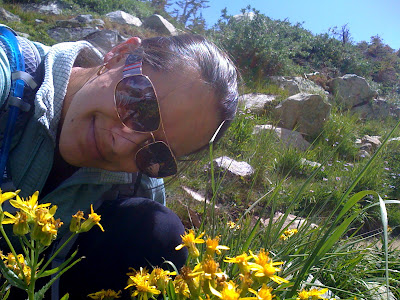 Needing to capture myself in the moment, of course, with pretty flowers.
 This picture has everything you can expect from Colorado: mountains, snow, greenery, flowing water — and a brewing afternoon thunderstorm.
 Such an amazing trail. I am so lucky that I happen to live here.
 Rolling home solo in the mountains, Camelbak in the passenger seat — just the way I like it.
Yesterday I ventured up into Indian Peaks Wilderness (part of Arapaho National Forest) and did a three-hour hike between Mitchell Lake and Blue Lake in an open valley at around 11,000 feet... and it was the most breathtakingly beautiful hike I've done here. I went by myself, because that's how I roll.
 Mind you, all of these photos were taken with a 2-megapixel camera on an old iPhone with no zoom function.
 The colors on these rocks were absolutely jaw-dropping.
 Needing to capture myself in the moment, of course, with pretty flowers.
 This picture has everything you can expect from Colorado: mountains, snow, greenery, flowing water — and a brewing afternoon thunderstorm.
 Such an amazing trail. I am so lucky that I happen to live here.
 Rolling home solo in the mountains, Camelbak in the passenger seat — just the way I like it.
Saturday, August 15, 2009
Newsweek: a great example of what journalism needs
I have been thinking this for a while now, and it's time I come out and say it: Newsweek—I am so, so proud of you.
I remember seeing piles and piles of the old you lying around my mother's house in New Jersey, sandwiched between the Asbury Park Press and old paper napkins scented with her gin and tonics. My mother had a fairly ambivalent attitude toward you, and I took that on as I grew up, even as I became a journalist. I didn't understand the point of you, and I don't think my mother did either. I adored the Washington Post, especially their Sunday magazine, but something about you... I just didn't get what you and TIME contributed to the conversation.
But now, things have changed.
“There’s a phrase in the culture: ‘we need to take note of,’ ‘we need to weigh in on,’ ” said Newsweek’s editor, Jon Meacham in a New York Times article. “That’s going away. If we don’t have something original to say, we won’t. The drill of chasing the week’s news to add a couple of hard-fought new details is not sustainable.”
I could feel that doggedness in the magazine even when I was younger, that sense of obligation that made the publication seem more like an informed citizen's duty to read rather than a pleasure, rather than something that could provide enlightenment and spawn fresh discussion.
With Newsweek's redesign starting with their May 18, 2009 issue, the magazine overhauled the format they had going for 76 years and replaced it with something perfectly packaged for today's ever-changing journalistic landscape.

Think about it. How are most newspapers and magazines trying to stay in the game? They're starting Twitter accounts and begrudgingly keeping up with them, or finding an intern who's only requirement is to be under the age of 21 to do it.
But Newsweek rethought their entire publication and executed it not in small doses, but all at once—which made the entire thing that more stunning.
They had an entire issue where political satirist Stephen Colbert was their guest editor. He inserted his humor into bits of the magazine (which were clearly pointed out as his work), such as: "Recycling magazines, catalogs and newspapers is one of the easiest ways for liberals to feel good about themselves." And in his editorial piece where he discusses the topic of this week's issue, he writes: "Americans have many lingering questions about Iraq. (For example: where is Iraq?) I wanted to find the answers."

Publicity stunt? Maybe, but it worked, it was damn hilarious, and the issue still had wonderful content. For those of us who respect high-quality journalism—but can also enjoy the humor of publications like the Onion—this was absolutely perfect.
The magazine is now divided into four clear sections: "short newsy items, essays and commentary, longer features and cultural coverage. It is printed on higher-quality paper, which instantly will make it feel better in your hand. I think the new design is sophisticated and airy, and makes the stories we work so hard on seem more inviting," said Assistant Managing Editor Kathleen Deveny in the "Reinventing Newsweek" column.
But it's more than the content. Newsweek has finally figured out that design can make or break a publication.
Most importantly—they're bringing a necessary lightheartedness into journalism, which has gotten way too serious in this seemingly desolate landscape. In the Colbert issue, he writes: "I sent Newsweek's reporters to find out whatever happened to Iraq. Unfortunately, this meant cutting the cover story they had planned: 'Hey, Have You Heard About This Thing Called Twitter?"
I remember seeing piles and piles of the old you lying around my mother's house in New Jersey, sandwiched between the Asbury Park Press and old paper napkins scented with her gin and tonics. My mother had a fairly ambivalent attitude toward you, and I took that on as I grew up, even as I became a journalist. I didn't understand the point of you, and I don't think my mother did either. I adored the Washington Post, especially their Sunday magazine, but something about you... I just didn't get what you and TIME contributed to the conversation.
But now, things have changed.

“There’s a phrase in the culture: ‘we need to take note of,’ ‘we need to weigh in on,’ ” said Newsweek’s editor, Jon Meacham in a New York Times article. “That’s going away. If we don’t have something original to say, we won’t. The drill of chasing the week’s news to add a couple of hard-fought new details is not sustainable.”
I could feel that doggedness in the magazine even when I was younger, that sense of obligation that made the publication seem more like an informed citizen's duty to read rather than a pleasure, rather than something that could provide enlightenment and spawn fresh discussion.
With Newsweek's redesign starting with their May 18, 2009 issue, the magazine overhauled the format they had going for 76 years and replaced it with something perfectly packaged for today's ever-changing journalistic landscape.

Think about it. How are most newspapers and magazines trying to stay in the game? They're starting Twitter accounts and begrudgingly keeping up with them, or finding an intern who's only requirement is to be under the age of 21 to do it.
But Newsweek rethought their entire publication and executed it not in small doses, but all at once—which made the entire thing that more stunning.
They had an entire issue where political satirist Stephen Colbert was their guest editor. He inserted his humor into bits of the magazine (which were clearly pointed out as his work), such as: "Recycling magazines, catalogs and newspapers is one of the easiest ways for liberals to feel good about themselves." And in his editorial piece where he discusses the topic of this week's issue, he writes: "Americans have many lingering questions about Iraq. (For example: where is Iraq?) I wanted to find the answers."

Publicity stunt? Maybe, but it worked, it was damn hilarious, and the issue still had wonderful content. For those of us who respect high-quality journalism—but can also enjoy the humor of publications like the Onion—this was absolutely perfect.
The magazine is now divided into four clear sections: "short newsy items, essays and commentary, longer features and cultural coverage. It is printed on higher-quality paper, which instantly will make it feel better in your hand. I think the new design is sophisticated and airy, and makes the stories we work so hard on seem more inviting," said Assistant Managing Editor Kathleen Deveny in the "Reinventing Newsweek" column.
But it's more than the content. Newsweek has finally figured out that design can make or break a publication.
The new magazine is loaded with style. The palettes are softer and more elegant. New fonts are used in the magazine, including Archer, a signature font of the most un-Newsweek of all magazines: Martha Stewart Living. Cerebral and direct, unsnarky and anti-ironic, with cool hues and fonts to match.
“It’s so beautiful and open and a very modern serif font,” said Bonnie Siegler, the founder of Number 17, the design firm Mr. Meacham hired to redesign the magazine, speaking about the use of Archer in the magazine.
— from an article in the New York Observer

And these things, like font choices, do matter and it takes a great editorial team to really get that. Writers tend to want to believe their writing will rise above the need to have stunning photographs and compelling design. Unfortunately, in today's world—it does not. It just won't be noticed as much.
What's more—Newsweek does use Twitter, and they do it right. Before their issue on July 13, 2009 on books came out, they held a roundtable with six authors and live-tweeted the discussion. The quotes were incredible, things like Elizabeth Stout's reason for writing: "It's just a compulsion. It's absolute madness in a way, I think. The few times that I contemplate not doing it, it's almost like there's a flavor that leaves ordinary life." Now that is something you'd want to see on your Twitter home page.Most importantly—they're bringing a necessary lightheartedness into journalism, which has gotten way too serious in this seemingly desolate landscape. In the Colbert issue, he writes: "I sent Newsweek's reporters to find out whatever happened to Iraq. Unfortunately, this meant cutting the cover story they had planned: 'Hey, Have You Heard About This Thing Called Twitter?"
Wednesday, August 12, 2009
Wend Wednesdays
Wend (wěnd) v. To go one's way; to proceed on or along
I am in a tea house, writing fervently and padding barefoot upon the wood floors, letting the day flow by, smooth and unruffled like a long, silk skirt. I am a low tide, calmed by the sounds of the beautiful rock, plant and water sculpture beside me, sipping green tea, the taste of it dry and grassy, as though I am tonguing the earth.

I have felt things changing lately. I am likely leaving the country in two months. I am only working four days a week now due to company finances; Wednesday will be my day off. I am getting in touch with the feminine sides of life in more ways than I ever have; I even prefer the company of women to men, whereas in the first 20-something years of my life it was quite the opposite. I am reading books to learn more about my sex.
Woman the bowl, the urn, the cave, the musky jungle. We are the dark mysterium! We are hidden folds and primal wisdom and always, always the womb, bearing life, releasing life, and then sucking it back in again, into those moist, chthonic plaits.
— "Woman: An Intimate Geography," Natalie Anger

I have gone twice to see a man in the mountains that my girl friends and I call "the Oracle," or Boulder’s version of a therapist. The first time, I genuinely wanted to know about every aspect of my future, past and present, and allowed him to do his job and contact my spirit guides.
The second time, I went to see him more as a distressed patient, due to a painful and unexpected personal interaction. I listen to the recording of this session and hardly recognize myself. My emotions were a pendulum caught in a tornado, wild and with many strong, opposing answers. I felt alternately faint and boiling, flickering between a thunderstorm and a generator defeated by one.
Through breath work, visualization and encouragement to communicate (and perhaps not in the way I originally intended, which I scrapped, as it was peppered with insults and nothing but negativity), I released it. It worked, it all worked. I became sea-worthy again, in the way that I always have. There is no slow build up with me, but a ferociousness followed by the quickest calm you will ever see. It is because of my mother, and I thank her for it, and I don’t at the same time.
I asked the Oracle if I should take an east coast road trip to see friends before I leave for Spain in November. Going to Spain is my only plan right now, and one that can only be halted by a salaried journalism/writing job. Although he told me quite strongly that Spain was the right choice (and that I had three past lives there, however you want to take that), he told me not to do the road trip.
"If you have things to say to people from your past, call or write them. But you do not need to go backwards," he said. "Save your money for Spain or go somewhere else for that time, but keep moving forward. Your soul is excited by travel, but it does not like to go in reverse."
I was okay with this, although there still were some people I felt I wanted to see in person.
Less than two weeks later, I unexpectedly got sent on a business trip to Washington D.C., where I got a chance to be with those people. Even someone from the North Carolina portion of my life drove up to see me. Things happen this way.
And now all I hope for is that in Spain, I am able to write consistently. That I will have access to post my writing so that others may read it, so that I may be able to funnel my energies and intentions and, basically, remain sane.
I feel like my writing is a laser inside of myself, and my daily life can make me cloudy. But when I’m in the right place, and I touch that laser, the only thing I can do is follow it to its end, and it is a path I am more sure of than anything else in my life. It is carved, it is set, I just need to follow it. Sandy, smooth, fiery or calm — whatever I need to be to do so.

Ray Bradbury writes in his essay, "The Joy of Writing," about doing what he loves from the core of his being, with passion and pride, even if some editors didn’t adore his work:
"But a lot of readers did. I claim no victory. But there was blood on my gloves when I hung them up."Blood on my gloves. In the spirit of Spain’s greatest (and most controversial) sport, bullfighting: olé to that.
Subscribe to:
Posts (Atom)