5-year-old Oscar: "Where are you from?"
Me: "I'm from New Jersey."
Oscar: "What is your..." ::pause:: "hairtage?"
Me: "Oh. Well, I'm American and Pacific Islander."
Oscar: ::frowns:: "Did your island sink?"
Saturday, January 7, 2012

Tuesday, December 20, 2011
Some go for the shoes; I go for the shawarma.
Last year, I went to Nicaragua with my ex. Right before our trip he expressed concern about the possibility of food poisoning.
"I might just not eat anything there," he said.
We were going to be there for two weeks. I was confused.
"What will you eat?" I asked.
"I don't know, I'll bring yogurt or something," he replied. I knew a pop culture reference was coming, something that convinced him this atrocity was pardonable. "You know, Charlotte-SATC-movie style."
It occurred to me that I wouldn't want to go if I couldn't eat the local food. If I couldn't immerse myself through taste, if I couldn't adorn my taste buds with what locals choose to nourish (or at least pleasure) their bodies… why go at all?
Since then I've come to embrace the fact that my travels revolve around food and people, with a side of alone time to write about food and people… while drinking a pourover coffee.
So before I visit my mother for a New Jersey Christmas, I am going to spend one full day in NYC. I am scrupulously plotting my meals, coffee breaks and wine-accompanied meriendas.
Before I maniacally try to cram the city's culinary craftsmanship into my belly during a 24-hour period, I am open to suggestions. So leave me a comment (mind you, my dinner slot is taken by Tertulia, recently reviewed in the Times—there's my love of Spain, ever surface level). Oh, and I will be reviewing every place I visit in a January 2012 post (and on NiftyNYC).
"I might just not eat anything there," he said.
We were going to be there for two weeks. I was confused.
"What will you eat?" I asked.
"I don't know, I'll bring yogurt or something," he replied. I knew a pop culture reference was coming, something that convinced him this atrocity was pardonable. "You know, Charlotte-SATC-movie style."
It occurred to me that I wouldn't want to go if I couldn't eat the local food. If I couldn't immerse myself through taste, if I couldn't adorn my taste buds with what locals choose to nourish (or at least pleasure) their bodies… why go at all?
Since then I've come to embrace the fact that my travels revolve around food and people, with a side of alone time to write about food and people… while drinking a pourover coffee.
 |
| Photo courtesy of Tertulia |
So before I visit my mother for a New Jersey Christmas, I am going to spend one full day in NYC. I am scrupulously plotting my meals, coffee breaks and wine-accompanied meriendas.
Before I maniacally try to cram the city's culinary craftsmanship into my belly during a 24-hour period, I am open to suggestions. So leave me a comment (mind you, my dinner slot is taken by Tertulia, recently reviewed in the Times—there's my love of Spain, ever surface level). Oh, and I will be reviewing every place I visit in a January 2012 post (and on NiftyNYC).
Monday, October 24, 2011
Pizza, Love and Jesus
The farm-to-table concept of making a connection between farmers, food and consumers has finally, in recent years, become cherished—and people in Boulder County are taking food authenticity to a moralistic level.
 |
| Flippin' pies at Locale. Photo by: Vandenoever |
“They were like, ‘Why don’t you just use dirt from Boulder?’” said Chris Donato, general manager of Pizzeria Locale. “They didn’t understand that it was an authentic thing, that it was going to be more of an art piece.”
TSA destroyed those materials. What you’ll see when you walk into Locale is the second attempt, an oven made by Ferrara and shipped over, pre-made on the soil that is the home of what most agree is the best pizza in the world.
Traditional European food culture embodies the elements of simplicity and craftsmanship—a duo Americans haven’t, until recently, been accustomed to seeing served together. Only in the last several years have Americans started to value high-quality food (U.S. sales of organic food and beverages grew from $1 billion in 1990 to $26.7 billion in 2010) and make an effort to become knowledgeable about where their food comes from.
Chef Jordan Wallace of Locale spent four months in Italy working at pizzerias, studying the art of pizza-making in Naples before the restaurant opened in Boulder.
“We wanted to have the exact same thing that’s offered on the streets of Naples,” Donato said.
Everything from the V.D.F. prosciutto slicer (hand-crafted by father and son team Mirco and Gary Schnidero) to the arrival of the pizza to your table uncut—which annoys some diners—is a nod to authentic Napolitan style and tradition.
“The pizza isn’t pre-cut because there’s lot more moisture to it; our mozzerella is very fresh so it’s really watery, the San Marzano tomatoes have more water to them, and we store mushrooms in oil so they’re richer,” Donato said. “If we cut the pizza for you, the water seeps into the dough faster, compromising the integrity of the dough.”
Donato said Locale is not about kitsch, but rather, holding true to tradition.
“People have been doing things this way for hundreds of years,” Donato said. “If you do things one way for that long, you end up producing something beautiful.”
After spending two years in Girona, Spain, fiancées Coral Ferguson and Will Frischkorn opened Cured, a cheese shop, in downtown Boulder. But they haven’t left their European ideals behind.
“European culture around food is so thoughtful. It’s not convenience-focused,” Ferguson said. “It takes more time out of their day, but it’s time they enjoy because so much of their life is focused around food.”
Cured has a small-market feel, with sections of the shop dedicated to local fruit and vegetables, cheese, bread, cured meats, wine and freshly made to-go items such as salads and sandwiches.
Frischkorn said he hopes to help people become more knowledgeable about their local food and farmers through the presentation of their products (read: samples abound!) and hosting weekly classes.
“We’ll bring in different purveyors, cheese makers and brewers, and teach people how farmer’s grow things, about the composition of the soil,” he said. “None of the cheese will be cut and wrapped in plastic. You’ll be able to try everything.”
Cured isn’t about importing European delicacies, but selling specialty meats and cheeses from the states, further expanding the growing movement toward local, fresh, simple food.
“We have so many incredible restaurants here, but we want to teach people that if you have quality ingredients, you can create incredible meals anywhere,” Ferguson said. “It doesn’t take a massive amount of tools or skill.”
Sarah Amorese designed downtown Boulder’s Piece, Love & Chocolate like a European boutique based on her travels.
“There’s a chocolate shop on every block in parts of France,” Amorese said. “It’s just the way they treat food: everything is smaller, there’s more attention to detail and craft, and there’s such respect for the purveyors and the ingredients.”
Amorese said she was amazed how food—even basic staples—was revered in France.
“I was in the Camargue [region] where fleur de sel comes from, and there was this huge festival of rice going on. Just rice. There was even a rice princess,” she said.
The shop’s open-glass chocolate case, based on that of a shop in Beaune, France, displays the truffles like jewels.
“We designed it so there would be more conversation,” Amorese said.
This sense of personal connection combined with experience of European culture provides the backbone for well-traveled locals trying to maintain the authentic experience.
“Our whole shop will be filled with products that speak to us,” Frischkorn said.
And if you don’t see the oven first in Locale, you’ll definitely see Jesus. Floating prominently above the bar and hand-carved in 1905, the piece was an opening gift representative of the religious and cultural tradition in southern Italy.
“If you walk into a pizzeria, there should be some Jesus,” Donato said.
Amy Segreti is a journalist and editor living in Boulder. She strives to live purposefully with regard to place, pleasure and palate. Especially palate.
Monday, September 12, 2011
Behind the Scenes: Being a Master Sommelier
A version of this article was published in the September 2011 issue of Rooster Magazine, of which I am the managing editor. Enjoy!
How to be a master sommelier
Your exams are nothing compared to this.
Photos and interview by: Amy Segreti
Take it from Master Sommelier Bobby Stuckey, co-owner of Frasca, winner of a James Beard Award and runner of marathons—even if you fail an exam five times, you can still be a baller. Rooster sat down with Bobby to get behind the scenes of becoming a master sommelier, which involves passing an exam that 90% of testers fail every year, due mostly to its rigorous tasting requirements. Want to try it? Let us put a glass of wine in front of you and then tell us all about it—acidity, grape, country of origin, district and appellation of origin, and vintage. Exactly.
What made you want to become a Master Sommelier?
I had been a sommelier since 1994, and when I went after the master sommelier diploma, I really struggled. So many people meet resistance with the master som degree, and a lot of my peers were wondering why I wanted to do it. I said, I’m not doing this for you or for an employer, I’m not doing it to get a raise—I’m doing it for myself. So I kept plugging away. I joke that I think I spent more on my MS degree than on my college education.
How many tries did it take you to pass the exam?
It took me six times. If you pass [the parts of] service and theory, you have two more tries to get through tasting, or you have to give up all the parts you’ve passed and take them again.
How did you train your palate to be able to pick up incredibly subtle nuances in wine?
The hardest part is recalling your olfactory memory when you’re stressed out. So I developed a new technique. The six months before my last attempt, when I passed in 2004, I totally changed how I tasted. I began tasting red wines before whites, and it made it much easier for me.
Interesting. At wine tastings, you almost always taste white wines first.
Exactly. But I felt that I personally tasted the nuances of acidity in white better after I had the red, so at the exam I asked to taste that way. It worked for me, but it was a crazy idea.
Take us behind the scenes of the tasting part of the exam.
You walk into a room and you have six wines in front of you; there are two master sommeliers in front of you and one taking notes behind you, writing down what you say. It’s you against the clock and you have 25 minutes to get it done. Say you’re tasting a white wine—before you came in, the master soms wrote down five flavors off the palate: lemon lime, cut grass, bell pepper, etc. Then they labeled it: alcohol medium, acidity high, length long, etc. So when you’re tasting, you name those elements, and they check off those boxes [on a tasting sheet] for you.
So you don’t need to give a description of say, “mustard seed,” to gain points.
Right. Some people will try to use shotgun descriptors trying to get a point or two, but that’s not what they’re looking for.
What was the strangest thing you had to learn in order to pass the exam? For example, we heard you get to learn about Havana cigars…?
Yes, I had to do a whole cigar service in London. But once I learned what I was getting into, I learned it was all relevant, learning those classic things. I mean, other than the Flagstaff House, there isn’t a restaurant in Boulder that has really old dishes, like beef rossini, or an old-school prep of fish—and those are the types of questions you get asked in service. A lot of young soms haven’t worked in an environment like that, and that becomes stranger and stranger for them.
Do you feel that becoming a master sommelier was worth it in terms of running Frasca?
Worth it? Totally. There are very few master sommeliers that run a restaurant, or at least that stay on the floor. The business is tough, and it’s a young person’s activity; for example, last Saturday night [August 13] we had our busiest night in seven years, and the older you get, the harder it is to put out that wattage every night.
We overheard you talking to a table of diners who asked you what your role was at Frasca and you joked, “I’m the head bus boy.”
There’s a lot of people who don’t even think I own this place, and that’s my style—being part of the craft of the service. Being a master sommelier definitely helps me run this restaurant, because I’m better able to deal with those thresholds of effort.
How has earning this degree affected you personally?
It makes me more empathetic. When Matthew, my employee, didn’t pass tasting this time, it was a lot easier for me to understand what he was going through. It’s nice to mentor younger people. It also teaches you humility. You see a lot of young sommeliers who are arrogant, but very rarely do you see a master sommelier who is arrogant.
How to be a master sommelier
Your exams are nothing compared to this.
Photos and interview by: Amy Segreti
Take it from Master Sommelier Bobby Stuckey, co-owner of Frasca, winner of a James Beard Award and runner of marathons—even if you fail an exam five times, you can still be a baller. Rooster sat down with Bobby to get behind the scenes of becoming a master sommelier, which involves passing an exam that 90% of testers fail every year, due mostly to its rigorous tasting requirements. Want to try it? Let us put a glass of wine in front of you and then tell us all about it—acidity, grape, country of origin, district and appellation of origin, and vintage. Exactly.
 |
| Bobby Stuckey |

I had been a sommelier since 1994, and when I went after the master sommelier diploma, I really struggled. So many people meet resistance with the master som degree, and a lot of my peers were wondering why I wanted to do it. I said, I’m not doing this for you or for an employer, I’m not doing it to get a raise—I’m doing it for myself. So I kept plugging away. I joke that I think I spent more on my MS degree than on my college education.
How many tries did it take you to pass the exam?
It took me six times. If you pass [the parts of] service and theory, you have two more tries to get through tasting, or you have to give up all the parts you’ve passed and take them again.
How did you train your palate to be able to pick up incredibly subtle nuances in wine?
The hardest part is recalling your olfactory memory when you’re stressed out. So I developed a new technique. The six months before my last attempt, when I passed in 2004, I totally changed how I tasted. I began tasting red wines before whites, and it made it much easier for me.
Interesting. At wine tastings, you almost always taste white wines first.
Exactly. But I felt that I personally tasted the nuances of acidity in white better after I had the red, so at the exam I asked to taste that way. It worked for me, but it was a crazy idea.
Take us behind the scenes of the tasting part of the exam.
You walk into a room and you have six wines in front of you; there are two master sommeliers in front of you and one taking notes behind you, writing down what you say. It’s you against the clock and you have 25 minutes to get it done. Say you’re tasting a white wine—before you came in, the master soms wrote down five flavors off the palate: lemon lime, cut grass, bell pepper, etc. Then they labeled it: alcohol medium, acidity high, length long, etc. So when you’re tasting, you name those elements, and they check off those boxes [on a tasting sheet] for you.
So you don’t need to give a description of say, “mustard seed,” to gain points.
Right. Some people will try to use shotgun descriptors trying to get a point or two, but that’s not what they’re looking for.
What was the strangest thing you had to learn in order to pass the exam? For example, we heard you get to learn about Havana cigars…?
Yes, I had to do a whole cigar service in London. But once I learned what I was getting into, I learned it was all relevant, learning those classic things. I mean, other than the Flagstaff House, there isn’t a restaurant in Boulder that has really old dishes, like beef rossini, or an old-school prep of fish—and those are the types of questions you get asked in service. A lot of young soms haven’t worked in an environment like that, and that becomes stranger and stranger for them.
 |
| Frasca Food and Wine |

Worth it? Totally. There are very few master sommeliers that run a restaurant, or at least that stay on the floor. The business is tough, and it’s a young person’s activity; for example, last Saturday night [August 13] we had our busiest night in seven years, and the older you get, the harder it is to put out that wattage every night.
We overheard you talking to a table of diners who asked you what your role was at Frasca and you joked, “I’m the head bus boy.”
There’s a lot of people who don’t even think I own this place, and that’s my style—being part of the craft of the service. Being a master sommelier definitely helps me run this restaurant, because I’m better able to deal with those thresholds of effort.
How has earning this degree affected you personally?
It makes me more empathetic. When Matthew, my employee, didn’t pass tasting this time, it was a lot easier for me to understand what he was going through. It’s nice to mentor younger people. It also teaches you humility. You see a lot of young sommeliers who are arrogant, but very rarely do you see a master sommelier who is arrogant.
Wednesday, July 20, 2011
Hot media, two media, three media, four
Newsosaur Alan D. Mutter always sparks insightful discourse on the journalism industry.
His post, "Time to Bring Back a P.M. News Product," highlights an idea similar to the one discussed at length in this month's Economist magazine: that "everything old is starting to look new again," that the way news was shared hundreds of years ago—by people in communities and coffee shops gossiping, sharing and even adding to the day's news—is reflected by today's social media hodgepodge.
Journalism started as a conversation; it's now returning to that state.
Also. My thoughts on Google+:
Monday, June 27, 2011
I am writing short stories again

Hermeneutics.
The art of interpreting.
The study of the theory and practice of interpretation.
A word can inspire a story can inspire an examination of self.
Thank you, Lorrie Moore, Jonathan Safran Foer, Julio Cortázar, and every other author who has inspired me to write outside of the linear.
The other day a stylist who was washing my hair said, "It's strange, your hair holds so much water. It turns pitch black."
Jump in
wet things
see what they dry like.
Sunday, June 26, 2011
The outside making the inside safe
I have found a little sanctuary in Keystone, Colo. called Inxpot. I'm here on a mini-vacation, hiking and relaxing yet oddly surrounded by a Bacon festival and distracted by resort conversations like:
"He called me last night after he got pulled over on the way back to the hotel."
"But I thought he was walking back."
"He was. He got pulled over walking."
But everything is ok in here.
When I claim spots as sanctuaries, I mean that they satisfy both inner and outer aspects of the meaning: inside of my head and my outside surroundings. I need a blend of something, of music and intellect, a concoction of words and wind and movement, of quotes scrawled on walls—"Live where your friends will defend you, but never have to"—and of men alone reading with an intensity to not notice any of it. An outside space created to foster one's inner space.
Inxpot is part coffee shop, part bookshop and part bar. It really only has six full shelves of books, but somehow the diverse collection managed to keep me occupied for an hour and a half before I became inspired to write. Although it's situated in a resort, the café has managed to maintain an air of authenticity. And within that, I can be authentic to myself.
A confession: I haven't read in a while. Not really read—not sat down with a book and let it devour me, let it cloak me so people can't find me anymore until I am done with it. I have skimmed New Yorker articles with spotted interest; I have read Facebook updates with embarrassing voracity. I am worried about my brain. I have started to read articles about how our brains are changing and our attention span may be waning, but I cannot finish them before I move on to something else. I am worried about my brain.
Yet "I am worried" does not accurately reflect how I feel every day. I am so many things to myself and to so many people—and I love it, and it's scary to live this way, and I never admit that, but it is. When you build a thing of many different types of wood—pecan, maple, yellowheart—they must be soldered together with exquisite care to create a solid piece, or things can be unsteady and give you splinters when you rub yourself across their many lives within a life.
 Taken with my awful iPhone 1 camera, but I am still so very excited!
A little over a week ago, I celebrated my four-year "crash-iversary," and I hiked my first Colorado 13er yesterday: Mt. Sniktau. I am so in love with Colorado and its mountains that it frightens me. I have never come back to live in a place after leaving it. I have never annoyed so many people with how much I love a place before, but I figure those who are left will be as enamored with life as I am—the ones who will defend me but never have to—and those are the people I build my wood-woven existence with.
And sometimes I need to find a sanctuary like this café, where I can remember that I am safe. Sometimes it's a teahouse, or a rose garden, or a spot on the earth where I can weave grass through my hair, green-brown life threadings, my heart starting and stopping, feeling the in-between of things—and I can feel that it's safe inside there too, because I make it that way.
"He called me last night after he got pulled over on the way back to the hotel."
"But I thought he was walking back."
"He was. He got pulled over walking."
But everything is ok in here.
When I claim spots as sanctuaries, I mean that they satisfy both inner and outer aspects of the meaning: inside of my head and my outside surroundings. I need a blend of something, of music and intellect, a concoction of words and wind and movement, of quotes scrawled on walls—"Live where your friends will defend you, but never have to"—and of men alone reading with an intensity to not notice any of it. An outside space created to foster one's inner space.
Inxpot is part coffee shop, part bookshop and part bar. It really only has six full shelves of books, but somehow the diverse collection managed to keep me occupied for an hour and a half before I became inspired to write. Although it's situated in a resort, the café has managed to maintain an air of authenticity. And within that, I can be authentic to myself.
A confession: I haven't read in a while. Not really read—not sat down with a book and let it devour me, let it cloak me so people can't find me anymore until I am done with it. I have skimmed New Yorker articles with spotted interest; I have read Facebook updates with embarrassing voracity. I am worried about my brain. I have started to read articles about how our brains are changing and our attention span may be waning, but I cannot finish them before I move on to something else. I am worried about my brain.
Yet "I am worried" does not accurately reflect how I feel every day. I am so many things to myself and to so many people—and I love it, and it's scary to live this way, and I never admit that, but it is. When you build a thing of many different types of wood—pecan, maple, yellowheart—they must be soldered together with exquisite care to create a solid piece, or things can be unsteady and give you splinters when you rub yourself across their many lives within a life.
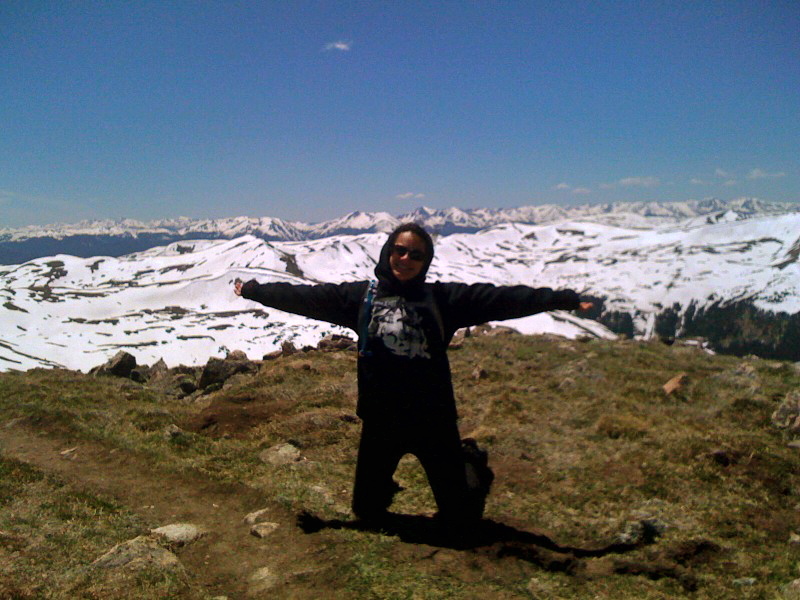 Taken with my awful iPhone 1 camera, but I am still so very excited!
A little over a week ago, I celebrated my four-year "crash-iversary," and I hiked my first Colorado 13er yesterday: Mt. Sniktau. I am so in love with Colorado and its mountains that it frightens me. I have never come back to live in a place after leaving it. I have never annoyed so many people with how much I love a place before, but I figure those who are left will be as enamored with life as I am—the ones who will defend me but never have to—and those are the people I build my wood-woven existence with.
And sometimes I need to find a sanctuary like this café, where I can remember that I am safe. Sometimes it's a teahouse, or a rose garden, or a spot on the earth where I can weave grass through my hair, green-brown life threadings, my heart starting and stopping, feeling the in-between of things—and I can feel that it's safe inside there too, because I make it that way.
Subscribe to:
Posts (Atom)