Showing posts with label writing. Show all posts

Friday, March 9, 2012

A thing to admit

"Admit" is a word you'd have to teach an English learner very carefully. It brings with it a weightiness; it's a thing you've been carrying around that you really need to set down for a minute. It brings to mind the idea of burden, of secret magnitude. It is not bulbous but meaty, made of stone and carved in the dark alleys of your impulses.

Here is something I'd like to admit:

I hardly ever read (entire) books.

I carry them around a lot. I buy them new, often at full price, and carry them with my laptop while headed to a coffee shop or wine bar to write or edit. Then, I sit them on the table in front of me... and open my laptop. And close it. And leave, books thumbed but not truly entered.

Due to the nature of coffee shop tables—often sticky with cream, sugar, ink that's escaped a page—the books I bring begin to look worn. I go, I come, I take them to my car where they are subject to the weariness of travel. They are on the passenger side floor next to the magazine I edit, they are in the backseat on top of my yoga mat, they are next to me under my Spanish teaching books, fellow warriors in the odd metallic bookcase that is my car.

But they are not often in my hands. Their words remain on the pages and don't travel through me—just, with me.

My current "books I'm walking around with" pile.
Often, we admit things because we'd like to change them. Or, we'd like to think that the admission will spur a change without us having to try so hard. If the whole world can see my faults, perhaps when I am in a coffee shop a friend will come by and ask, "How is that book?" with a wink, and I will know they are part of the team I created to conspire against myself to make me close my laptop, stop working on whatever I'm editing—and editing is also an art to me, but it's so close to my soul art of writing that I can do it and feel productive without producing—and read.

I'm an editor and a writer, but so much of what I do is not reading. I write a piece, and though I'll look it over several times for errors and places to amplify it, this is not reading. I edit other people's work, pull it apart and gnaw on it. And oh, how I remember the details—"This isn't my edited version, this hyphen is not an em dash." But I may not remember the heart of it, even if the peelings are scattered next to me.

To read and read well is a practice. It helps craft the imagination. It helps me sink into that place where I can pull things out and place them, sweaty-handed, on the table in a collage of emotion and inspiration. Reading is the other half of my writing, it is the folded-over blanket, the curve of the body that is so different from the back than the front, but it is still the same body. It is the salve to my ache when that ache is writing, when I have been so far away from it that it scares me. It is the stimulator to my over-edited mind. It is the—here, we're done, we've traveled in and through and out today… where shall we go next?

Monday, June 27, 2011

I am writing short stories again


Hermeneutics.

The art of interpreting.
The study of the theory and practice of interpretation.

A word can inspire a story can inspire an examination of self.

Thank you, Lorrie Moore, Jonathan Safran Foer, Julio Cortázar, and every other author who has inspired me to write outside of the linear.

The other day a stylist who was washing my hair said, "It's strange, your hair holds so much water. It turns pitch black."

Jump in
wet things
see what they dry like.

Sunday, June 26, 2011

The outside making the inside safe

I have found a little sanctuary in Keystone, Colo. called Inxpot. I'm here on a mini-vacation, hiking and relaxing yet oddly surrounded by a Bacon festival and distracted by resort conversations like:

"He called me last night after he got pulled over on the way back to the hotel."
"But I thought he was walking back."
"He was. He got pulled over walking."

But everything is ok in here.

When I claim spots as sanctuaries, I mean that they satisfy both inner and outer aspects of the meaning: inside of my head and my outside surroundings. I need a blend of something, of music and intellect, a concoction of words and wind and movement, of quotes scrawled on walls—"Live where your friends will defend you, but never have to"—and of men alone reading with an intensity to not notice any of it. An outside space created to foster one's inner space.

Inxpot is part coffee shop, part bookshop and part bar. It really only has six full shelves of books, but somehow the diverse collection managed to keep me occupied for an hour and a half before I became inspired to write. Although it's situated in a resort, the café has managed to maintain an air of authenticity. And within that, I can be authentic to myself.

A confession: I haven't read in a while. Not really read—not sat down with a book and let it devour me, let it cloak me so people can't find me anymore until I am done with it. I have skimmed New Yorker articles with spotted interest; I have read Facebook updates with embarrassing voracity. I am worried about my brain. I have started to read articles about how our brains are changing and our attention span may be waning, but I cannot finish them before I move on to something else. I am worried about my brain.

Yet "I am worried" does not accurately reflect how I feel every day. I am so many things to myself and to so many people—and I love it, and it's scary to live this way, and I never admit that, but it is. When you build a thing of many different types of wood—pecan, maple, yellowheart—they must be soldered together with exquisite care to create a solid piece, or things can be unsteady and give you splinters when you rub yourself across their many lives within a life.

Taken with my awful iPhone 1 camera, but I am still so very excited!

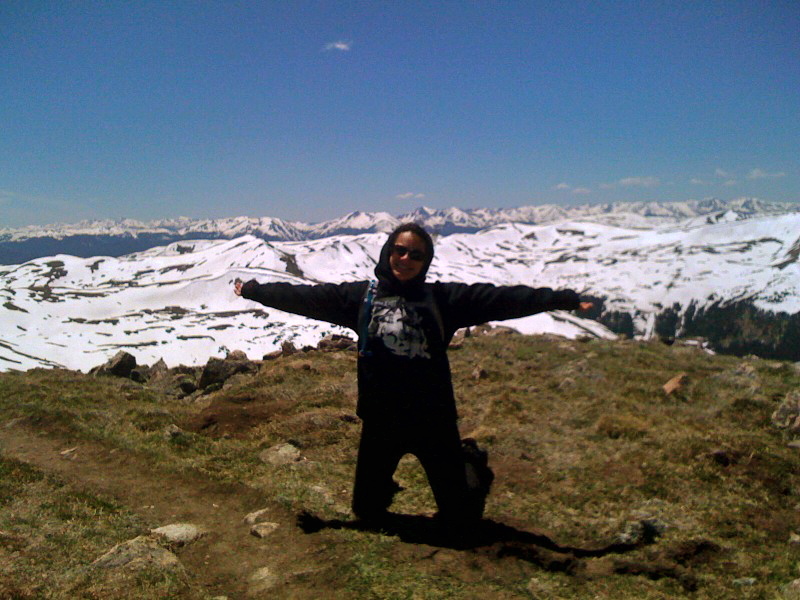
A little over a week ago, I celebrated my four-year "crash-iversary," and I hiked my first Colorado 13er yesterday: Mt. Sniktau. I am so in love with Colorado and its mountains that it frightens me. I have never come back to live in a place after leaving it. I have never annoyed so many people with how much I love a place before, but I figure those who are left will be as enamored with life as I am—the ones who will defend me but never have to—and those are the people I build my wood-woven existence with.

And sometimes I need to find a sanctuary like this café, where I can remember that I am safe. Sometimes it's a teahouse, or a rose garden, or a spot on the earth where I can weave grass through my hair, green-brown life threadings, my heart starting and stopping, feeling the in-between of things—and I can feel that it's safe inside there too, because I make it that way.

Wednesday, April 20, 2011

Overheard: reminders from writers

I'm sitting at Trident Café (as I do often) overhearing an interview between two male writers and an author named Sara.

When one of the writers asks her why she moved to Boulder, she says that she had been in Thailand wondering where to move next, and as she was doing yoga looking out her window, an intense wave of feeling washed over her and she saw Boulder. She saw the mountains.

"My sister was living [here] and I called her and said, 'Don't tell anyone, but I'm going to ship all my things from Thailand to you and I'm moving there.'"

When asked how she felt about Boulder, Sara replies:
"It's felt like a really good incubation place to write my book, to connect with a lot of other like-minded people, to have access to great teachers, to have access to nature—which is one of my great teachers—and to really strengthen myself internally and externally."
This is the point when I find out she was diagnosed with an illness; I'm not sure which.

Sara is a runner, yoga practitioner, meditator, hiker. It seems her book focuses on the idea of exercise helping to self-heal.

"I have a lot of fire energy, and I like to turn that inward to heal myself," she says.

I look at her more closely; she is beautiful. Healthy. Strong.

"I don't regret how things happen," she says. "I'm not a victim."

Thank you, Ms. Unknown Writer, for the reminders.

Saturday, March 26, 2011

Creating for creating: portable sacred space for artists on the go

"Creativity, like many things, gives back when you use it." (Molly O'Keefe)

I was in Paris when I met Roberto. He spoke five languages, introduced me to neighborhood markets and bourgeois bars, and attempted to teach me tango (although I was too faint with awe at that point to remember any steps). He was writing a lengthy research paper about impoverished neighborhoods of Paris, and told me that in order to have time to write, he brought his laptop on his hour-long train commute.

“Even if I only get one perfect sentence out of it—it's worth it,” he said.

Modern writers, artists and other creatives wonder how sacred creative space can fit within a fairly commute-oriented work life. Author Kelly L. Stone writes that when we make space for creating, it naturally becomes a safe and comfortable place for one's muse to emerge. Much like a Pavlovian response, simply going into the space will energize the creative process.

But what can we do when our lives don’t allow us to sit home all day and create?

Believe it or not, we can assemble a portable version of a sacred space in the form of supplies: bags, drawing tools, notebooks, folders. It sounds simple, but your mind will help your muse along. It’s all about ritual and repetition.

Here are some ideas for coaxing out your traveling muse:

  • designate a notebook only for your creative ideas. Don’t write to-do lists in it (that's what your planner is for) or phone numbers. Make it sacred and it will give back to you.
  • get a large purse or handbag and put all of your creative materials in that bag. Find a few things (quotes, photos, drawings) that are motivational to you and keep you on your path and throw ‘em in.
  • for days when you’re feeling uninspired, include a token of your past success. For my business partner, Heather, this is easy; she can take an actual bag. For me, I would take a writing contract or a clip of a published article I’m particularly proud of.

The important part is the power of association you’ll create almost effortlessly each time you use your traveling sacred space for its purpose. You can be anywhere; it can involve coffee or Chardonnay (like perhaps it is for me right now...). It can even be on a noisy, crowded train in Paris. If you’ve decided that this is your creation time and make it a ritual—that’s what it will be.

Note to Boulder/Denver folks: check this out. It's a free, Denver-wide, creative-space-finder (who knew?) for artists in the area.

And let me know your secrets—how do you create your sacred artistic space?

Note: I wrote the original version of this article for the local Boulder-based eco-company, English Retreads.

Monday, March 21, 2011

Key lime pie and that is all except for the so much more

My ex always used to bring me water. Before bed, at a café, wherever—but at night was when it mattered. He did it half-asleep once, in the hours when there is no light, only feet peddling against sheets. Then he drank all of it and got up again to get more. There was never any question.

—


I carried a key lime pie around my house tonight. For several hours, without eating it.

I carried it from its Whole Foods' bag in the kitchen into my room where I called my ex. He talked, I listened, then I saw the pie sitting on my desk chair. I began to get angry; he was standing in the way of me and my pie. I hung up.

Instead of getting my pie, I almost immediately called another ex. I stopped. I examined why I flew down this reactionary, pie-less path. I got out my journal to write about it.

I wrote, then started creating something that could be a big something. It was going to be called The Purpose Project, but it might not be because of this and these guys. It will be something else. It's in my journal now gestating, growing limbs.

I noticed the pie was still on my chair, but now I had to go to the bathroom. I took my pie into the bathroom, which I realize is gross. It sat on my sink for a while, until I realized I hadn't written in my blog for quite some time, since before the ex was an ex. I brought the pie to my bed, where it is now sitting next to me as I type, looking soggy and more like lemon key pie.

But I am writing. In journals and on keyboards. I am creating although it is just me right now, me and my Monday nights and stacks of books and long, dusty brain-hallways. But how sweet and pie-worthy it all is.

—

I am eating my pie now. I am thirsty. But I am going to keep eating.

Tuesday, February 1, 2011

R e l a t i o n s h i p

When you are little, you have boyfriends and girlfriends, and you call this a relationship. You go through that, think it is fun. Perhaps you will collect multiple of these? So you have another, and another, a relationship in the wholeness of the word, the beautiful simplicity, the non-dissectedness of it. Relationship. Fun!

Then you have another, and you are larger and have another, and the word grows—and becomes scary. It's growing bigger and you're growing bigger and relationship needs to mean more, but it is still just one thing. Just one word—so why this opening and closing, and then a deeper closing because of the deep opening, and then the deepest closing you didn't think you were capable of? Because you haven't figured it out yet, you haven't learned the secret. Relationship is playing with you now, because you think you have met it, but it has been giggling at you from behind its secret the whole time, Wizard of Oz-like.

And then one day you meet someone. And you realize.

You look at the word again. Turn it upside down, with him. Spread it out, spread yourself out further than you thought you could. There are things inside you never saw before.

Now you see an r. And an a. And a ship and an elation. And it's all there, and it's so grand and powerful that you are so small on this ship with your elation, and your ions and your re. And you look around at this new world, and wow.

Relationship.

This is huge.

And fun!

Tuesday, August 3, 2010

Spanish beer inspires me to write about other beer

My piece on international brews and bars, published in InMadrid, the city's English-language newspaper:

Have we got brews for you

Craving something other than Mahou or Cruzcampo? Amy Segreti tells you where you can find great beer from Germany, Belgium and elsewhere without leaving Madrid.


José Luis Ramírez doesn’t want you to have any distractions when you come to his bar. His beer haven, Oldenburg (C/Alburquerque, 13, Metro: Bilbao), appears in the Guinness Book of World Records for having the world’s largest selection of cerveza in the smallest space–14.4 square meters to be exact.

No distractions means no television to watch the fútbol game, no Wifi for checking e-mail, no cigarette machines, no juice machines, nor anything else that characterizes old Spanish bars, even though Oldenburg was founded over two decades ago. And although you’ll find pinchos, salchichas (hot dogs) and a wonderful tortilla de patatas on Fridays and Saturdays, you won’t find anything else to drink besides beer and Coca-Cola, which Ramírez only started serving two years ago when his long-time clients began to have children.

“When you come, you must come only to drink beer,” says Ramírez firmly. And that is something he makes very easy.

Oldenburg offers more than 150 bottled beers from all over the world, as well as half a dozen on draft. And despite the great variety, there is a distinct lack of snobbiness about the bar, which is decorated in beer memorabilia and showcases a small model of Oldenburg, the city in Germany the bar is named after.

“There is no such thing as ‘bad beer’,” says Ramírez. “They are all different.”

While some of us may beg to differ, there are enough options in the thick menu to satisfy everyone. Toward the back of the menu you’ll find a glossary of terms defining each style of beer and lengthy descriptions of the areas in Belgium in which each beer is made.

And if you’ve seen Te Deum beer around Madrid, it’s because Ramírez helped to create it in Belgium in 2002, hecha al gusto español (made to suit the Spanish taste). Eight years later, it is still only manufactured and bottled by Du Bocq brewery in Belgium and shipped to Spain, the only country permitted to sell and distribute it.

“The Belgians say the only defect Te Deum has is that it doesn’t contain enough alcohol,” says Ramírez.

If you can’t decide what to order, you can always try the beer of the month; order two and you’ll receive a glass especially made for that beer. Ramírez started the program in 1998 because he found a lot of his clients always drank the same thing, year after year. “It’s easier to say, ‘Have you tried our beer of the month?’” says Ramírez. “If you start listing specific beers, they don’t pay you any attention.”

If you want to focus specifically on Belgian beer, just behind Plaza Mayor you’ll find Cafeeke (C/Cuchilleros, 3, Metro: Sol), where attentive waiters speak several languages and there are plenty of small flat screens to watch the games. Prices are a bit higher, which is to be expected because of its central location (you’ll pay 5.40€ for a Delirium Tremens, a bit less for others). However, it has a cozy upstairs salon and if you come with your pet to have a drink on the terrace, dog treats are provided free of charge.

Cafeeke carries 50 bottled Belgian beers and five on draft. Try the Mongozo coconut beer, which comes in a coconut shell (but ask for a spoon, as the rich mixture quickly separates).

If you’re looking for microbrewed beer made in Madrid, try both Naturbier (C/ Plaza de Santa Ana, 9, Metro: Sevilla) and Magister (C/Príncipe, 18, Metro: Sevilla). Naturbier claims to produce the only “natural” beer in Madrid; they don’t use any chemicals in the beer’s production, and you’ll get it straight from the cask in which it was produced. Right down the street is Magister, which is similar to Naturbier with the wonderful exception that you can choose which of the 10 free tapas you’d like to accompany your brew. The quality of the beer is adequate, and there are usually around three options.

Finally, a Spanish chain named La Fábrica: Museo de la Cerveza (C/Princesa, 5, Metro: Plaza de España, and C/Génova, 21, Metro: Alonso Martínez, among others), offering almost 20 different types of Spanish and world beer, deserves an honorable mention. It serves as a restaurant as well, so you can eat your meat and potatoes with your beer and admire interesting collectibles that showcase the evolution of the Spanish brewing industry since the 19th century.

Wednesday, April 28, 2010

Bread crumbs, bridges, the sometimes of things

A journalist friend who worked at El Mundo for 14 years asked me recently what I would be doing in Spain if I could choose. I didn't have an immediate answer. I had to dig around in the pockets of my desires and pull up linty wishes and mold them into recognizable shapes for him. Ah, yes — that dream, that place, that job. This is enough to tell me that my intentions aren't clear enough for the universe to hear them.

"Have you been writing lately?" my friend Sara asks, and already I am reaching for my glass of wine, trying to avoid the question.

"No," I say, and start thinking of an excuse — I've been to the United States again, I'm feeling out of sorts lately, I've moved in with a new family in Madrid and they take up all my time.

And sometimes it feels like they do. I can incorporate exercise by playing with the 2-year-old baby, Alvaro. I do plank pose and he drives toy trucks under the length of me. I am a bridge always in danger of collapsing, and this makes him giggle. However, when I try to write and he spies my Macbook (I mistakenly showed him the cool sounds the volume keys make), he starts manically poking at the keyboard. And I let him because it's cute, and with the way I feel lately perhaps using this method might yield a better piece of writing.

And so I don't give Sara an excuse, because she already knows that part of me.

"You told me to tell you that when you're not writing, it means you're not being honest with yourself," she says, and I curse smarter, month-ago Amy.

It's true. Writing is a meditation for me. I can feel my mind focusing, filtering, wading out to sea.

I live on the edges of myself too often here. It feels safer. Sometimes I feel alone and scared in this country, and paradoxically too vulnerable to go deeply with anyone. Because if I access that route, I leave bread crumbs, and people can follow me in there.

I constantly ask myself what all of this is worth. The Spanish language, of course, but what else? Do I need to know now? Why am I always trying to frame works of art that haven't taken their shape yet?

My friend Harvin saw a psychic recently, and when I came up in the conversation she told him that what I'm doing right now will help me in my career. I wanted to fly to D.C. and shake her and say, "What am I doing? Please God tell me what it is. I don't feel it, please help me feel it!"

And then I did go to D.C. last week. And I didn't shake her, or see her. I was too happy to be home.

Friday, January 22, 2010

Wisps and wafts and circumstance


Who am I? If this once I were to rely on a proverb, then perhaps everything would amount to knowing whom I "haunt."

— "Nadja," Andre Breton

Wednesday, January 20, 2010

Say "hello" and I will love you forever


On owning a language

I was standing on the Metro today reading To The Lighthouse. Its cover is unmistakably English, the title screaming to everyone my native tongue.

When I want to appear Spanish I don't read it. Instead I read ADN, a free city paper (primarily available in suburban neighborhoods, another plus for my disguise). I gasp or chuckle at some article or another, thereby demonstrating my ability to read and understand the Spanish language.

But today I felt more like absorbing words rather than walking among them, occasionally having to tap one on the shoulder and ask, excuse me, what do you mean in this particular context?


So I chose Ms. Woolf. I looked up to see what stop I was at, and that was when I saw it. Smeared vulnerably across the face of a man of about 40 years. The look. The "please say something, anything, in English!" look. Floating there so exposed, above his cheeks that were gently etched with wisp-thin lines, like a palm.

It's a look I know well, because I give it to others on days I feel most lonely, when I see someone reading in English, or pass by people speaking it. One time in Chueca I meandered around three people talking about their English teaching experiences like a silly satellite, waiting for a way to break into the conversation. But there didn't appear to be an opening, so I shuffled away.

This is one of the more difficult aspects of being here. I am at an intermediate (some days low, some days high) level of Spanish, and I often feel trapped inside of myself because of the language barrier. I'm trying every single day, talking to people, reading newspapers, books, study materials, watching Spanish telenovelas. I am listening, always. I am putting myself out there; I am trying hard enough.

But when I start to think deeply about language and communication, as I have been lately, I feel that I might not be able to know another language intimately. To the point where I can express, for example, that sometimes I feel like a paper bag billowing in the breeze of someone's departure, gulping up thick mouthfuls of the air he leaves behind, my lips caked with dried longing. I am not able to pour things out of myself in another language, and I don't know if I ever will be.

There are moments to the contrary, of course, where I'm able to see the beauty of not needing words. Zoe, a girl from London who I befriended in Spain, was in pain over the recent burial of her grandmother, and she wanted to explain it to her Spanish friend, Cristina. She wasn't able to be there for the burial in London, so her family emailed her photos. She showed a picture of the box of ashes to Cristina and said, simply, "Mi abuela."

And she said the simplicity of that was comforting, that she didn't have to explain everything surrounding the death of her grandmother. That she could just say those two words and it was enough. That, essentially, the limitation was freeing. Freeing her from saying unnecessary words and, perhaps, the trouble of not knowing where to start or end, and allowing her to express herself in just two.


I am so drawn to the Spanish language, and I intend to be fluent in it. But maybe fluency is different than knowing a language intimately, the way an artist uses language, as threads for weaving. You don't go digging for threads; they are already there, and it is the final artistic product that takes the effort. Maybe I will create art with Spanish words someday.

Or maybe I won't.

And that's the interesting thing about living in another country. You learn things about yourself you did not expect. For instance, I am in love with the language I already own. It's almost as if I feel I need to explore English more, because these words are my tools, because I am a writer and can be nothing else.

But as for the man on the Metro, I will admit — he and I didn't need words.

Images: #1, "Raining words," Flickr user pfv; #2, snow-day in Madrid, Amy Segreti

Wednesday, December 9, 2009

Tuesday, October 20, 2009

The comforts of staying

I bought some hot apple cider this afternoon and took a walk around Boulder, fogging up my sunglasses with cinnamon-nutmeg steam.

I forget how much I love autumn. I wrote a short story last year about "the season of turmeric and spices, of osmanthus and scarf-worn longing." Today there was a scarf — a red one, my favorite, that my friend Christian bought for me in India — but there was no longing. Just appreciation, a kind of breath-driven inner peace, the kind you feel after a deep stretch.

I love knowing a city so well. I know that when I walk past a certain cafe that my best friend's boyfriend will be in there, working away on his next book. I know that the bathroom code to the local bookstore changes every week, and I always remember it until it no longer works. I know which intersections are always okay to cross even when the lights are green, because they're hardly ever used.

I know it will take me 12.5 minutes to walk from my work to my favorite local gourmet deli, where I harass them for their wild Alaskan house-cured salmon. I love learning through Facebook that a favorite cafe — where Christian and I would discuss our impending plans to travel the world over mochas and scones — is now serving hot apple cider, made from locally-grown apples; I love that I can walk there from my job, which is less than .5 miles away, because everything is less than .5 miles away.

I love that last night, as I was eating a delicious squash risotto with my close girl friend at my favorite restaurant, the bar manager — also my ex and friend — pointed at a table of diners and said, "They grew that squash you're eating."

I love feeling like I'm the only one who knows where a beautiful tea house is right downtown, because there's hardly anyone there. I love having places to retreat outside of my home, and not having every inch of my city crowded with people.

I love knowing that at least one out of five of my closest friends will likely be at the local "herban" bar at any given point on a late afternoon, working on art, illustration, writing, or just drinking jun.

I like growing, and discovering that when I really want to live in a place — the settle-down kind of live — it will probably be a smaller city, because I just like knowing. My life is filled with going and staying, but I am gaining so much in the process.

And when it comes to Boulder — I'm so glad I stayed.

Tuesday, September 22, 2009

The Secret Lives of Raindrops

When I was little, I would study raindrops with a scientific intensity as they crawled down my mother's car window. I would play games with myself, guessing which ones would come together and barrel furiously to the end of their lives at the bottom of the window, fueled by their union. My mother would holler, and I would be quiet and watch them, wondering about the few that didn't find partners along the glass, who rolled softly and wearily to their ends. It was a way for me to turn inward while looking outward.


There are so many different ways to write. I am constantly amazed.

I picked up this book of short fiction today, "The Secret Lives of People in Love." I'd seen it before; I was originally turned off by the title, although I have several secret lives.

But I opened it up today at the Boulder Bookstore and read one of Simon Van Booy's three-page short-shorts, "The Reappearance of Strawberries." It was unbelievable. A dying man is staring out the window at the rain, requesting only strawberries on his final days, and he has a memory of a girl he should have been with.

He observed how each raindrop united with its closest other and then, split open by its own weight, ran down the glass in one even corridor. Even after her family was killed, he did nothing—not one thing.

Without memory, he thought, man would be invincible.

And this—how incredibly short and powerful it is, how it stirs a hot meringue of admiration and envy within me—is why I write.

Here is the back of his book. Martin Page's review is one that would cause me to die happily if I were to receive it.


Saturday, August 15, 2009

Newsweek: a great example of what journalism needs

I have been thinking this for a while now, and it's time I come out and say it: Newsweek—I am so, so proud of you.

I remember seeing piles and piles of the old you lying around my mother's house in New Jersey, sandwiched between the Asbury Park Press and old paper napkins scented with her gin and tonics. My mother had a fairly ambivalent attitude toward you, and I took that on as I grew up, even as I became a journalist. I didn't understand the point of you, and I don't think my mother did either. I adored the Washington Post, especially their Sunday magazine, but something about you... I just didn't get what you and TIME contributed to the conversation.

But now, things have changed.


“There’s a phrase in the culture: ‘we need to take note of,’ ‘we need to weigh in on,’ ” said Newsweek’s editor, Jon Meacham in a New York Times article. “That’s going away. If we don’t have something original to say, we won’t. The drill of chasing the week’s news to add a couple of hard-fought new details is not sustainable.”

I could feel that doggedness in the magazine even when I was younger, that sense of obligation that made the publication seem more like an informed citizen's duty to read rather than a pleasure, rather than something that could provide enlightenment and spawn fresh discussion.

With Newsweek's redesign starting with their May 18, 2009 issue, the magazine overhauled the format they had going for 76 years and replaced it with something perfectly packaged for today's ever-changing journalistic landscape.


Think about it. How are most newspapers and magazines trying to stay in the game? They're starting Twitter accounts and begrudgingly keeping up with them, or finding an intern who's only requirement is to be under the age of 21 to do it.

But Newsweek rethought their entire publication and executed it not in small doses, but all at once—which made the entire thing that more stunning.

They had an entire issue where political satirist Stephen Colbert was their guest editor. He inserted his humor into bits of the magazine (which were clearly pointed out as his work), such as: "Recycling magazines, catalogs and newspapers is one of the easiest ways for liberals to feel good about themselves." And in his editorial piece where he discusses the topic of this week's issue, he writes: "Americans have many lingering questions about Iraq. (For example: where is Iraq?) I wanted to find the answers."


Publicity stunt? Maybe, but it worked, it was damn hilarious, and the issue still had wonderful content. For those of us who respect high-quality journalism—but can also enjoy the humor of publications like the Onion—this was absolutely perfect.

The magazine is now divided into four clear sections: "short newsy items, essays and commentary, longer features and cultural coverage. It is printed on higher-quality paper, which instantly will make it feel better in your hand. I think the new design is sophisticated and airy, and makes the stories we work so hard on seem more inviting," said Assistant Managing Editor Kathleen Deveny in the "Reinventing Newsweek" column.

But it's more than the content. Newsweek has finally figured out that design can make or break a publication.
The new magazine is loaded with style. The palettes are softer and more elegant. New fonts are used in the magazine, including Archer, a signature font of the most un-Newsweek of all magazines: Martha Stewart Living. Cerebral and direct, unsnarky and anti-ironic, with cool hues and fonts to match.

“It’s so beautiful and open and a very modern serif font,” said Bonnie Siegler, the founder of Number 17, the design firm Mr. Meacham hired to redesign the magazine, speaking about the use of Archer in the magazine.

— from an article in the New York Observer

And these things, like font choices, do matter and it takes a great editorial team to really get that. Writers tend to want to believe their writing will rise above the need to have stunning photographs and compelling design. Unfortunately, in today's world—it does not. It just won't be noticed as much.

What's more—Newsweek does use Twitter, and they do it right. Before their issue on July 13, 2009 on books came out, they held a roundtable with six authors and live-tweeted the discussion. The quotes were incredible, things like Elizabeth Stout's reason for writing: "It's just a compulsion. It's absolute madness in a way, I think. The few times that I contemplate not doing it, it's almost like there's a flavor that leaves ordinary life." Now that is something you'd want to see on your Twitter home page.

Most importantly—they're bringing a necessary lightheartedness into journalism, which has gotten way too serious in this seemingly desolate landscape. In the Colbert issue, he writes: "I sent Newsweek's reporters to find out whatever happened to Iraq. Unfortunately, this meant cutting the cover story they had planned: 'Hey, Have You Heard About This Thing Called Twitter?"

Wednesday, August 12, 2009

Wend Wednesdays

Wend (wěnd) v. To go one's way; to proceed on or along

I am in a tea house, writing fervently and padding barefoot upon the wood floors, letting the day flow by, smooth and unruffled like a long, silk skirt. I am a low tide, calmed by the sounds of the beautiful rock, plant and water sculpture beside me, sipping green tea, the taste of it dry and grassy, as though I am tonguing the earth.


I have felt things changing lately. I am likely leaving the country in two months. I am only working four days a week now due to company finances; Wednesday will be my day off. I am getting in touch with the feminine sides of life in more ways than I ever have; I even prefer the company of women to men, whereas in the first 20-something years of my life it was quite the opposite. I am reading books to learn more about my sex.
Woman the bowl, the urn, the cave, the musky jungle. We are the dark mysterium! We are hidden folds and primal wisdom and always, always the womb, bearing life, releasing life, and then sucking it back in again, into those moist, chthonic plaits.
— "Woman: An Intimate Geography," Natalie Anger


I have gone twice to see a man in the mountains that my girl friends and I call "the Oracle," or Boulder’s version of a therapist. The first time, I genuinely wanted to know about every aspect of my future, past and present, and allowed him to do his job and contact my spirit guides.

The second time, I went to see him more as a distressed patient, due to a painful and unexpected personal interaction. I listen to the recording of this session and hardly recognize myself. My emotions were a pendulum caught in a tornado, wild and with many strong, opposing answers. I felt alternately faint and boiling, flickering between a thunderstorm and a generator defeated by one.

Through breath work, visualization and encouragement to communicate (and perhaps not in the way I originally intended, which I scrapped, as it was peppered with insults and nothing but negativity), I released it. It worked, it all worked. I became sea-worthy again, in the way that I always have. There is no slow build up with me, but a ferociousness followed by the quickest calm you will ever see. It is because of my mother, and I thank her for it, and I don’t at the same time.

I asked the Oracle if I should take an east coast road trip to see friends before I leave for Spain in November. Going to Spain is my only plan right now, and one that can only be halted by a salaried journalism/writing job. Although he told me quite strongly that Spain was the right choice (and that I had three past lives there, however you want to take that), he told me not to do the road trip.

"If you have things to say to people from your past, call or write them. But you do not need to go backwards," he said. "Save your money for Spain or go somewhere else for that time, but keep moving forward. Your soul is excited by travel, but it does not like to go in reverse."

I was okay with this, although there still were some people I felt I wanted to see in person.

Less than two weeks later, I unexpectedly got sent on a business trip to Washington D.C., where I got a chance to be with those people. Even someone from the North Carolina portion of my life drove up to see me. Things happen this way.

And now all I hope for is that in Spain, I am able to write consistently. That I will have access to post my writing so that others may read it, so that I may be able to funnel my energies and intentions and, basically, remain sane.

I feel like my writing is a laser inside of myself, and my daily life can make me cloudy. But when I’m in the right place, and I touch that laser, the only thing I can do is follow it to its end, and it is a path I am more sure of than anything else in my life. It is carved, it is set, I just need to follow it. Sandy, smooth, fiery or calm — whatever I need to be to do so.


Ray Bradbury writes in his essay, "The Joy of Writing," about doing what he loves from the core of his being, with passion and pride, even if some editors didn’t adore his work:
"But a lot of readers did. I claim no victory. But there was blood on my gloves when I hung them up."
Blood on my gloves. In the spirit of Spain’s greatest (and most controversial) sport, bullfighting: olé to that.

Thursday, April 23, 2009

Plane writing: New York City

I travel to explore myself more fully.

This morning, I missed the AB bus to the Denver airport. It was the first time I'd ever done that. When I realized I'd have to drive, I went to the Brewing Market for coffee where a box of soy milk exploded onto my newly-highlighted hair and the only sweater I am bringing to New York. I laughed because that's all you can do sometimes.

And on the plane, I am reading the New Yorker and finding in it a treasure trove of things that stir me up, that add new flavors to my inner soupy mixture. It is the April 20th issue. I am taking notes. I write:

- the idea of having "blood-knowledge"
- "Porter had a habit of inviting ruin into her home so that she could flee it."
- rephrased: "The funny thing about writing is that, in order to have anything to write about, one has to live — i.e. not be writing."
- page 112, third column — amazing piece on "negative liberty"

I looked up this "negative liberty" idea when I began to write this. The phrase comes from the following passage regarding the fear that comes from creating one's art (in this case, writing).

"Dyer's characters failed to write not because they were indifferent to writing but because they wanted too much to write. Negative liberty expresses a fear of completion; if you never start a work, then at least there is no chance of your having finished it. To complete something is in some ways to make it disappear; not starting it is a preemptive strike against loss, a way of elegizing what has not yet disappeared."

This idea deeply resonates with me. I love writing more than anything else in the world, and sometimes find it hard for me to sit down and do it. There is nothing I would rather do, there is nothing I would rather be than a writer — and the fear that I can't even do that sometimes, often times, when I would rather lose myself in some rap song, some simplistic magazine — that terrifies me.

I know a lot of artists who go through this. Who can sometimes do everything but their work on a day when all they really want to do is their work. But, to do that work is a purposeful want — it's a desire that is so close to our hearts that the fear of disappointing ourselves feels fatal. If we want to go to a museum and then fail to do so — when we arrive, we're just not in the mood anymore — it doesn't feel so bad. But if we want to create meaningful prose and then fail to do so, after we have already arrived with our laptops, our keys, our latte steaming the screen, our fingers, finding our thoughts drifting away from us — it can make one doubt the core of her being.

Back on the plane, I am so inspired by this magazine, by this particular issue. I am devouring it, I am eating a grilled vegan salad, I am warning the stewardess of my severe peanut allergy. I walk around the plane in socks. I turn off the personal television screen with snobbery guiding my finger. I have bursts of inspiration, necessitating pulling out a pen, a tiny notebook and writing frantically. I have four pens in my purse, two blue, two black, pain colors, but also catharsis colors.

I yearn to find someone else on this plane going to the live This American Life show, because, to me, listening to that radio show means something about a person. It indicates patience, imagination, pleasure in creating your own visuals. It shows an openness and acceptance of other people's emotions and how they can alter your insides. It proves that you believe, even if it's subconscious, that we are all connected, that we all have stories worth telling, and that through our experiences we can help others. It indicates an appreciation of words and the crafting, molding and artistic placement of them.

And all of that matters to me, because they are things I value in myself.

Friday, April 17, 2009

Creativity and something rooted

One of the most amazing TED videos I've ever seen is Elizabeth Gilbert's recent talk on nurturing creativity. In it, she talks about the societal pressures that a writer, artist or any creative being has to deal with and muses on the idea that maybe we could relieve some of those pressures if we viewed our "genius" and our selves as separate entities. That maybe, our inspiration is outside of ourselves and it is all we can do to capture it and bring it to life so that we can share it, in the form that we know and have been put on this earth to create, with the rest of the world.

She uses as an example the American poet Ruth Stone, who's now in her 90s. When Ruth was working in rural Virginia, she said that sometimes she would feel a poem coming at her like a "thunderous train of air" across the landscape. It would shake the earth, and when she felt this inspiration coming, Ruth would "run like hell" to her house, so that when the poem barreled through her, she could collect it. If she didn't make it in time to her pen, the poem would continue on looking for another poet. The times when she almost missed it, Ruth would catch the poem by its tail and she would pull it backwards into her body as she was transcribing and "the poem would come up on the page, perfect and intact, but backwards from the last word to the first."

That is one of the most interesting things I've ever heard about creative inspiration and expression. Take 20 minutes of your day to watch this video if you find passion or love in creating anything at all; you will appreciate it.


And, in honor of April being National Poetry Month, I am posting one of my favorite modern poems. When I first read it, I unfurled myself at its feet. It is composed of three parts; the second part is always at my side, and the third was, for a long time. And I'm sure it will be again.

Suddenly, I Need One Thing Constant
by Mariahadessa Ekere Tallie

Poets should just
bring poetry
blank books and pens
passports and visas
and something rooted
something rooted
for the lives we will
eventually want
not the imitations
of our mentors' stumblings
the ancient lovers never loved
upheaval following us
like stubborn ghosts
poets should bring something rooted

II.

Wherever I go
I drag my mistakes
and my memory of the mistakes
of others. Wherever I go
I have to tell my stories
of crashings and rantings
and passion and laughing
of praying of living
and forgetting how to breathe

wherever I go
I start again:
a woman hates me
a man loves me
I meet people
I write
then I wonder, what is that far off sound
that call from another side of the ocean
what’s the name of that place
what language do they speak
how much does it cost to get there
and then I’m gone
leaving behind everything I wished for
making another list

III.

Stay with me.
Wherever I go
I want you
with me, among
the pens and blank
pages, yes, but
in the bed and bathroom
in the restaurants
with food we can’t pronounce
your hand smoothing the tired map,
mine tracing our route

stay/go/come
with me
as much as writing
as much as wandering
I know I need to start my days
folded in your scent


Saturday, March 14, 2009

Café writing and the absence of time

The problem for me of trying to write on a schedule is that I write best when I have no idea what time it is. When I have no idea what time I started writing and no idea when I stopped. When I have no concept of time, when a gigantic zucchini could walk by and wave at me and I would have no idea because I'm so entranced by the flow of energy and thoughts from my head to my fingers to my keyboard – that is when I write my best.

I have a 35-hour a week job, and I don't really want to do my writing in the office. I tried once, but the environment is off. I need a hot beverage, the wing-like flutter of laptop keys and conversation, ideas taking flight around me. I need the feeling of euphoric release when I write a sentence like that, something that depicts exactly what's inside of me. I can't succumb to that in my work office.

So, I have after-work hours. All right. But I have some very close female friends and I want to make time for them too, so there goes 2-3 evenings. Otherwise, I have gym time, which is also very important to me, so that I don't spiral into a lumpy depression resulting from excess weight and a lack of strength. Then, I have Amy Time, which I require and take regularly. I know that the phrase might be foreign to people in more bustling parts of this country
– well, not the phrase "me time" per say, but making a point to take it might not come as easily. I read somewhere that the pace of the city you live in dictates your internal pace, the speed at which your internal clock operates, which makes sense to me, but I wish I could remember the exact phrasing and research involved.

I'm lucky to have a job now, even if it is outside of the journalism industry.
This recession is, to put it briefly, scary. I feel the anger in people, even in Boulder. Cautiousness coming out as defensiveness. A manager at my gym recently attacked me for giving my girl friend a free pass – when they are the ones handing out free passes to attract more members – asking me hurriedly, "Is she going to join? She never returns my calls and emails! Is she going to join or not?" People are terrified, and if we're not, we can feel it in the air and it suffocates our own sense of calm.


Something that saddened me greatly was watching the folding of the Rocky Mountain News in Colorado. After 150 years, the oldest newspaper in Colorado published its final issue on Feb. 27.

"We're an odd bunch in this business. A collection of people who collect: data and facts and anecdotes and people and jokes and sketches. We are consumed by that collecting, by the act of organization and the way in which the random assembles and reassembles itself, revealing something new every time, an unturned corner, an unopened door, a story waiting."

Consumed. Yes. It is consuming, in the best way.


The above quote is from Tina Griego's goodbye column,
"This is what has called my heart." Staffers commented that writing articles for the final issue was like getting to choose the music played at your own funeral. I understand that; I felt that way when writing my own goodbye column in The Globe in North Carolina, and it was I who chose to leave it. And it's still being published. For now.

When working at The Globe, it was suggested to me to write a story on fossil hunting on Onslow Beach on the Marine base I worked on. I did some research and found a 55-year-old local woman who had an amazing, Smithsonian-worthy collection of fossils from that beach
– from various ice ages. Fossil hunting became her passion, it was what she did in her free time, when her Marine husband was sent to war, and all of these relics made up a significant part of her life, and in a way they were her life. She was so protective of them. I remember taking photos of her fossils for my article and she was concerned the camera flash might hurt them, so I didn't use it, and compromised by taking them outside and using natural light to capture their beauty.

I spent most of an entire week doing research for this article, talking to fossil club presidents and curators of paleontology at museums, but it was that woman who drew me in. If someone is passionate about something and I'm writing about what they love, I feel that fire and use it as fuel for my writing, and it comes so naturally to me.


Now, I constantly look at books on writing at the Boulder Bookstore, and I am amazed at how so many of them talk about searching for the urge to write, about "becoming" a writer, about being consistent and dedicated to improving your writing, as if it were something to work on, as if it were a creaky chain to lube, a long-term errand to finally check off. The authors' advice makes sense to me but, writing runs so much more deeply for me. It's not so... man-made.

I know my fr
iend Julia would understand; she is a painter, and it's something she does for a living, but she also lives and breathes it. It isn't that she went to school to learn to paint and decided that's what she would do for money and that was all; it runs in her blood. For me, there is nothing else. Well, there is everything else, but it is all filtered through writing. This is why I consider being a writer to be the best of all possible professions, because you can be interested in anything and you get to learn about it and write about it and tell others about it and get paid for it. How could a life consist of anything better than doing that, every single day?

Now that I don't have a dedicated 40 hours a week to write and get paid for it, I make necessary adjustments. It's not about finding a specific time block in which to write; for me, it's about being able to ask myself, will I need to be conscious and alert and ready to respond to people later on tonight? Or will it be all right if, at around 7 p.m. on a Saturday, I take myself to a café and allow myself to disappear for an unspecified block of time? I can come to a café and just let myself
feel whatever is buzzing in and around me, and then I float back into reality. And I'm so lucky that I get to keep what I've created.

Monday, March 9, 2009

The meaning of my blog title

I was listening to an episode of This American Life the other day, and something said in it had the eerie effect of making me feel hollowed out. I related to it in a visceral way.

The episode is #374: Somewhere Out There, and the theme is about the odds of finding another person in this world of 6.5 billion people – a friend, a lover, a pseudo-parent – who is a true match for you, and what happens when you find that person.

One of the acts tells the story of an American man, Eric Hayot (who speaks no Chinese), who falls for a Chinese woman, Yuanyuan Di (who speaks no English), loses contact with her and then tracks her down years later by searching the whole of China with only her name and her previous place of employment to go by. Eric says:

“That desperation of needing to find the person… just this sense that you have to find this person, it’s kind of overwhelming. I’m teaching Proust this week and so there’s this moment in Proust where Swann is falling in love with this woman and the way that he realizes he’s falling in love with her is he goes to this party that he’s supposed to meet her at, and she’s already gone. And then he drives his carriage through Paris and is going in and out of all of these restaurants and stuff, and you know, it’s all about how the act of looking for her causes him, in some sense, not only to recognize that he’s in love with her, but also actually to kind of really fall in love with her.” (16:30 into the podcast; listen to him say it, with the background music. Beautiful.)

I heard that and immediately thought about the car accident that changed my life.

-----

The title of this blog is Light on Broken Glass for two reasons. It refers most directly to a quote about writing:

“Don’t tell me the moon is shining; show me the glint of light on broken glass.”
– Anton Chekhov

It's about showing, not telling.

In a journal entry I once wrote about the end of a 2.5 year relationship, I never mentioned once how I was feeling. I never said, "I felt sad," or something cliché like, "My heart is breaking." In fact, I may have even gone too far, because I didn't mention the break-up at all, only the way I tried to piece myself back together by acquiring my first piece of art for my new solitary living space.

An older man at the store on Pearl St. helped me pick out a frame. I had never had anything framed before in my life, and at first he kept asking, "Which would you prefer?" and I tried to appear like I knew what I was doing, but my mind can't access its files on complementary colors right now and eventually I looked at him and said, "Well... what would you pick?" and it came out in this overflowing sort of way, and we were kneeling on the floor together and my eyes poured, "please" and he understood and we understood and he picked something beautiful, black with speckled gold to match the burgundy colors in the painting, and my studio will be beautiful and this is what I need. I need this beauty.

Three sentences. I wrote them in this way, following this rhythm, for a reason. At the time, it was all I could do to just keep flowing with things, to get through and around them, and I wanted to reflect that in my writing. This often comes naturally to me, thank goodness, and I'm happy to have been influenced by some amazing teachers and writers.

The other reason my blog is entitled as such is due to the car accident.

-----

Ian – the man I later needed to replace with a painting – and I were driving on I-70W just after midnight on June 15, 2007, headed for what we thought would soon be our new home, San Francisco. He was going about 90mph (the speed limit was 75mph), hoping to get to a hostel in Boulder where we could rest up before continuing our drive. I was in the passenger seat sleeping. He glanced at a map and began to veer toward the median – he hit a reflector pole in the middle of the road, and as a reaction to the impact, over-corrected the steering wheel to the right and slammed on the brakes. This caused my car to spin around in circles on the highway and flip over three times before coming to a stop, thankfully right-side up. I woke up mid-flip, screaming.


A UPS man pulled over, called 911 for us and told me not to move because I was having severe neck pain. While waiting for the police, he reminded us to choose UPS over FedEx (I'm not even joking), then the firemen came and put me on some sort of wooden board (it's a little fuzzy, it could have been something else) and carried me onto a helicopter, where they stuck me with an IV and sticker things to monitor my vitals, and flew me to an ER in Aurora. We had crashed in Limon, which is an incredibly small rural town in Colorado, and so they wanted me at a better-equipped hospital. Ian was driven to a hospital in the area we crashed in, as he had a minor cut on his arm – his hospital was equivalent in size to a living room.

They did MRI's, cat scans, X-rays, I have no idea, I was in shock. My legs wouldn't stop shaking. They asked me if I was cold. I don't think I understood the question. What I do remember is that they did this thing called a "contrast study" in which they told me that they were going to inject a fluid in me that would make my body warm, then they went away. I thought that sounded very nice, until it happened and the MRI machine started whirring and it felt like someone had lit my entire body on fire from the inside. It was the only time I cried.

Ian, being 85 miles away at a different hospital, hitchhiked with a guy driving a tractor trailer at around 4 a.m., then caught a cab from a gas station in the middle of nowhere to my hospital. After being separated immediately after a fairly traumatic accident, seeing him walking down the hospital hallway in my woozy and terrified state made him appear to me as my knight in shining armor – or, twisted metal, as it were. The idea of being torn apart, of wanting to be together, of searching and reuniting, made us recognize our love again and kept us together for the next 10 months.

Luckily, I had nothing more than severe neck strain, sprain and contusions (just bruises and some under-the-skin bleeding) on my back and shoulder and neck, mostly on the right side. It took three weeks for it to heal 95%, and it still hurt for a few months afterward, when I turned my head at a certain angle or attempted certain yoga poses.

Ian and I decided to stay in Colorado for a few weeks in Fort Collins, resting, healing and indulging in espresso ice cream and margaritas. We had a great ability to enjoy ourselves in any location, in any situation. Ian and I visited Boulder one day and decided to move in to a one-month sublet there with eight college students. Boulder was supposed to be temporary.

I began to fall slowly in love with the town, as I spent my days appreciating how my body could still move by hiking, tubing down the Boulder Creek, lying in the grass at the farmers' market and riding my new mountain bike.

I found my current apartment in an auspicious way. I had just finished interviewing for a front desk position at a legal firm just east of downtown. I was about ride my bike back to our sublet, but I noticed studio apartments two buildings away. I meandered around the apartment complex, just to see what it was like, and noticed an open door. Thinking it might be the front office and I could see if there were apartments available, I stepped inside and found myself standing inside a beautiful sunny studio with hard-wood floors, granite counter tops, a bay window and aesthetically pleasing mirror placement – and standing in front of a pleasant yet surprised shirtless guy playing the flute. His name was Dan, and I asked him where the front office was; he said it was somewhere off site, but let me look around his place. I fell for it, hard. I took Ian to see the apartments, and the woman showing us around took us somewhere else first – someplace smaller, in a basement, with carpet, but in the same complex.

"No!" I said. "You have to see the one I saw." And so Dan and I met again, for the second time that day. Again, he was shirtless and mildly embarrassed, but that is what you get for leaving your door open all the time. As I expected, Ian loved it as well.

Dan happened to be moving out in early September. And so Ian and I signed a lease – for that very same apartment, for I would have no other – a week or so later. I still live here, and although some people have wondered how I could have stayed, living with the ghosts of my relationship with Ian – they don't understand. There are no ghosts. It is filled with my energy, my spirit; this was always my place. I know Ian would agree.

-----

Since that summer, I've gradually gotten Boulder under my skin, from my initial infatuation to a deeply-felt connection. I've made friends, strengthened relationships, gained paintings, lost lovers, and changed, massively, from the person I was just two years ago. I feel more connected to nature, to my body, and I'm putting into action the self-awareness that had been dormant for much of my early twenties. It's amazing; I wouldn't change how I got where I am today, not for a second.

The only thing I could say was missing from my life as of a few weeks ago was writing. Maybe I felt that if I incorporated that element, I would have too much of a perfect existence, and that thought can be rather terrifying. It's full of risk. It's vulnerable.

But some of the best things can come out of those cave-like places. There can be light anywhere.